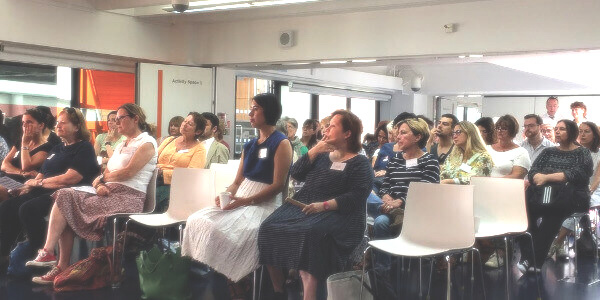
UK SUMMER CONFERENCE: SATURDAY 20th JUNE 2026
This year our summer conference will be held on Saturday 20th June. Please save the date!
We look forward to seeing you at the Museum of London (now known as London Museum).
More details will be posted here as they become available.
DATE, LOCATION, TIMING & COST
Date: Saturday 20th June 2026
Location: Museum of London, EC2Y 5HN
Timing: 10 a.m. to 4 p.m.
Sessions: TBC
Cost: £59.00 for teachers; £30 for PGCE and ITT students. Lunch and refreshments will be provided. Bursaries are available - please see our Grants and Bursaries page.
BOOKING
Please book your place by clicking the 'Book here' button below.
During the booking process, you may choose for us to invoice your school/institution.
If you choose to pay online, please use the 'Pay Online' button below once you have booked your place.
If you have been granted a bursary, select the 'I have been granted a bursary' option.
PAY ONLINE
If, during the Booking process above, you chose to Pay Online, please use the 'Pay Online' button below, and be sure to select the correct price.
PROVISIONAL TIMETABLE
| 10.00 – 10.30 | Coffee and Registration | ||
| 10.30 – 10.45 Welcome | |||
| Welcome | |||
| 10.45 – 11.30 Session 1 | |||
| A | A beginner's introduction to Suburani (Tony Smith) | ||
| B | Eduqas Paper 2: Ideas for teaching 'Come dine with me' texts (Will Griffiths & Sara Aguilar) | ||
| C | Reading Latin as intended - left to right (Laila Tims) | ||
| 11.30 – 11.45 | Break | ||
| 11.45 – 12.30 Session 2 | |||
| A | Starting a Latin club (Will Griffiths) | ||
| B | Preparing students for (OCR) GCSE: teaching Chapters 27-32 (Laila Tims) | ||
| C | Eduqas Paper 3A prescribed texts 28-29 (Ashley Carter) | ||
| 12.30 – 1.15 | Lunch | ||
| 1.15 – 2.00 Session 3 | |||
| A | Roman religion and festivals (Dr Ersin Hussein & Maria Oikonomou) | ||
| B | Hands on with Roman artefacts from the London Museum (Laura Turnage) | ||
| C | Introduction to Suburani digital resources (Tony Smith) | ||
| 2.00 – 2.45 Session 4 | |||
| A | What to not teach and how to not teach it (Will Griffiths) | ||
| B | New digital developments for Suburani (Tony Smith) | ||
| C | Retrieval practice in the Classics classroom (Dimitrios Xerikos) | ||
| 2.45 – 3.00 | Break | ||
| 3.00 – 4.00 Plenary | |||
| - | Ethical Responsibilities in Teaching (and Researching) Ancient Slavery (Prof. Richard Alston) | ||
| 4:00 p.m. | End | ||
SESSION DETAILS
Session 1
An introduction to Suburani
This session will introduce you to the Suburani Latin course. We'll look at its aims, some of its characters, the language topics it covers, and its mapping to Eduqas and OCR GCSE vocabulary and grammar. We'll also explore the locations in which the storyline is set, the book's approach to myth and history, and the topics included in the civilization sections.
Eduqas Paper 2: Ideas for teaching 'Come dine with me' texts
The aim of this session is to support the teaching of the new Eduqas literature Component 2 theme 'Come dine with me'. Our aim will be to consider the following questions: what do we need to know as teachers, and what do we need to teach the students? We will also discuss the order in which the texts could best be taught, and finally some general strategies for teaching literature texts. Of course, input from the audience on any of these topics will be very welcome!
Reading Latin as intended - left to right
Although it's not necessarily wrong to teach students to 'find the subject, find the verb, find the object', reading courses are designed to encourage students to read Latin from left to right, and so to become used to information flowing in a different order from that of English. In this session, we'll have a go at reading Latin left to right, starting simply at first, then trying the approach with slightly more complex sentences and stories, and investigate the difference between what is required for reading for understanding, and for writing down a translation. The session promises to be fun, enjoyable, and appropriate and accessible for all.
Session 2
Starting a Latin club - ideas, practicalities, advice, discussion
This session is appropriate for schools thinking of introducing Latin. We'll briefly explore what the modern study of Latin involves to help guide thinking on how to shape and position a Latin club, and which students might be most interested in it. We'll consider the age and ability range of students, ideas for combining year groups together, how to pace a course, techniques for motivating students, options for advertising to students and parents, managing expectations around continuation, how to get resources and grants, and a range of other practical issues to help ensure your Latin club gets off to a strong start.
Preparing students for (OCR) GCSE: teaching Chapters 27-32
This session explores the later chapters of the Suburani course (Chapters 27–32), examining how they build the linguistic and cultural knowledge students need as they approach the OCR Latin GCSE. We'll look at how to make the most of the grammar, vocabulary, and thematic content in these chapters, discussing practical strategies for consolidating learning and smoothing the transition from coursebook to exam preparation. Whether you're navigating these chapters for the first time, or looking to refine your approach, the session will offer ideas for keeping students engaged and giving them the confidence and skills to succeed in their GCSE.
Eduqas Paper 3A prescribed texts 28-29
In this session, Ashley Carter (for a long time the Principal Examiner for Eduqas GCSE Latin) will introduce you to the 28-29 Component 3A set texts (Cupid & Psyche, and Aeneas & Anchises), some of their key points of interest, and examples of style, in order to give you a sense of the texts, and help you decide which of the two your students might find more engaging, interesting, and accessible. You will leave the session with a good sense of both options, and perhaps the beginnings of a view of which set of texts you might choose for your students when the time comes.
Session 3
Roman Religion and Festivals
This interactive session explores the challenges of making Roman religion accessible to GCSE students. It offers opportunities to discuss resources and examples of classroom activities. Focusing on worship in both private and public spheres, it looks at evidence for household ritual and major civic festivals. Particular attention will be paid to the role and significance of women, with a focus on the Vestalia.
Hands on with Roman artefacts from the London Museum
Laura Thomson-Turnage, of the London Museum, will lead a hands-on session looking at, and exploring, Roman artefacts from the Museum's collection.
An Introduction to Suburani digital resources
This session is intended for those new to the Suburani digital resources. Tony Smith from Hands Up Education will demonstrate the extensive digital support for Suburani. Find out about the Activebooks with story explorers for the whole course; interactive exercises that track student progress (vocabulary trainer, verb trainer, sorting, auto-marked translations); games that are fun while practising Latin forms (Catena, Arepo, word search); and how to create classes, add and remove students, and so on. There will be plenty of opportunity for questions.
Session 4
What to not teach and how to not teach it
In the 8 years that Will taught A level Latin in a non-selective state school, his students (who didn't start Latin until Year 9) twice placed top in the country. GCSE Latin had the highest student numbers outside the core subjects. The secret? Perhaps counterintuitively, teaching less language content. In this session, Will will demonstrate ways you can strip away some of the perceived content burden of GCSE Latin, increase the pace of your course, drive up student numbers, and optimise reading competence and exam performance.
New digital developments for Suburani
In this session we'll look at new developments in the Suburani digital resources. In the Activebook story explorers there are extra controls to limit exactly what word help students can see. There's an experiment in revealing the text of the stories word by word, to encourage reading from left to right. You can also see how to set up customized exercises in the Verb Trainer, and how to use the session history when examining your students' progress in the Vocabulary Trainer. Some new programs will be demonstrated. There's a Word Endings program to exercise word inflections, and some new games: Odd One Out, Pairs, and Spelling Bee. You will also have the opportunity to ask questions about any aspect of the digital resources.
Retrieval practice in the Classics classroom
Explore how retrieval practice can drive effective learning in the Latin classroom, strengthening memory and improving long-term retention. This session focuses on practical, high-impact strategies that can be applied immediately. From sharp, purposeful starters to versatile activities for vocabulary, grammar, and translation, you will gain techniques that maximise learning. Whether you are refining existing routines or building new ones, you will leave with clear, efficient approaches that lead to measurable gains in student progress.
Plenary
Ethical Responsibilities in Teaching (and Researching) Ancient Slavery
Slavery is a ‘difficult’ topic. It brings us face to face with abusive, violent relationships that are at odds with narratives of Classical cultural excellence. It touches modern sensitivities, around abusive discrepancies of power, issues of race and identity, and cultural politics. In this talk, in which I draw on extensive experience of teaching and researching on Roman slavery, I argue that we have an ethical responsibility to teach Ancient slavery. Our responsibility is to the students who need to know, to the subject since slavery was central to Greek and Roman societies and social values, and most importantly to the slaves themselves. If History is an ethical responsibility to remember the dead, we need to remember the least powerful as well as the most powerful and the victims alongside the victors. Teaching about slavery raises fundamental ethical and social questions: why anyone could think it right that a particular individual was a slave? How could people think in that way and what does it mean about how we, as people, are? A Humanities education demands that we critically engage with inhumanity for only in doing so can we guide our students into what it is to live ethically.
Richard Alston is Professor of Roman History at Royal Holloway University of London. He has published widely on Roman social and political history and its reception in the modern world. Particular focuses of his work are issues of urbanism, political ideologies, imperialism, gender history and social inequality.
If you have any questions or queries, please do not hesitate to contact us.